Medical Alert Watches: A Straight-Talking Guide (Australia, 2026)
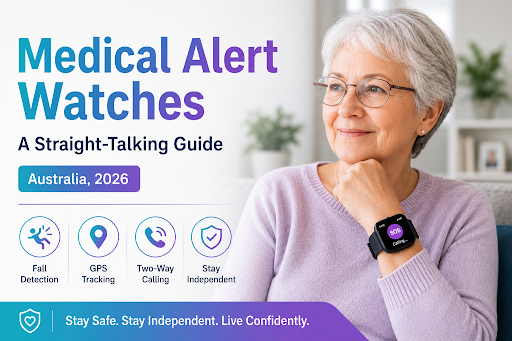
If you live on your own and want to feel secure — without wearing something that makes you feel old, or handing your independence to a gadget — this guide is for you. We'll walk through how medical alert watches work, what they cost in Australia, and how to decide what's actually right for you.
Let's be honest about something first: looking into a medical alert watch doesn't mean you're frail, or that you can't cope. It usually means the opposite — you're someone who likes to stay a step ahead, who wants to keep living independently in your own home, and who'd rather sort things out on your own terms than have decisions made for you.
That's exactly the right instinct. So let's go through your options plainly, with no scare tactics and no pressure.
What a medical alert watch actually is
It's a watch — it looks like an ordinary one — with some extra features built in for peace of mind:
- An SOS button you can press if you ever need help
- Automatic fall detection — if you have a fall and can't reach the button, it calls for help on its own
- GPS — handy if you're out and about and want family to be able to find you
- Two-way calling — you can actually talk to someone through the watch
The idea is simple: one discreet device on your wrist, so if something happens, you're not stuck with no way to call for help.
How the fall detection works
Inside the watch are motion sensors that quietly keep track of how you're moving. If they sense the pattern of a fall — a sudden drop, then stillness — the watch raises the alarm by itself, either to your family or to a monitoring centre.
It's clever technology, and it works well. Being straight with you: it's not perfect. Now and then it might raise a false alarm during vigorous movement, and very occasionally a real fall could be missed. It's a strong safety net — just not a guarantee. Anyone who promises you 100% isn't being honest.

What they cost in Australia
| Type | Rough price | Ongoing cost |
|---|---|---|
| Basic watch (SOS + fall detection) | ~$200–350 | Sometimes none |
| Full-featured 4G watch (GPS, calling, data) | ~$450–530 | Often includes 12 months data |
| Watch + 24/7 monitoring service | Device + ~$25–40/month | Monthly fee |
A good 4G watch with GPS and calling generally runs $300–530, sometimes with a year of mobile data included. Cheaper ones exist — just check whether there's a monthly fee hiding behind the low price.
What to look for
If you decide a watch suits you, look for:
- Automatic fall detection — the whole point; don't settle for just a button.
- Good battery life — 24 hours or more, so you're not charging it constantly.
- Two-way calling — so you can talk to whoever answers, not just send a silent alert.
- Waterproof — you want it safe in the shower, where a lot of falls happen.
- Comfortable and good-looking — honestly, if you don't like wearing it, you won't. That matters more than any feature.
You might not have to pay full price
Depending on your situation, you may get help toward the cost through Support at Home, the Commonwealth Home Support Programme, the NDIS, or a state program. If you already receive home care services, it's worth asking whether a medical alert watch or similar support may be included in your care plan. It's worth a quick call to My Aged Care on 1800 200 422 to ask what you might be eligible for before you buy anything.
The honest question: will you actually wear it?
Here's the thing most sales pages won't tell you. A watch only helps if you wear it and keep it charged. And plenty of people buy one, then find it lives in a drawer — because it's uncomfortable, or fiddly to charge, or just feels like a thing you have to manage.
If you know yourself well enough to say "I'd wear that happily" — great, a good watch is genuinely worthwhile. But if you suspect you'd take it off after a week, it's worth knowing there's a simpler option that asks nothing of you.
A simpler option: a daily call, nothing to wear
If what you'd really like isn't a gadget, but just someone checking in — a friendly voice each day, on your own phone, no device to wear or charge — that's worth knowing about too.
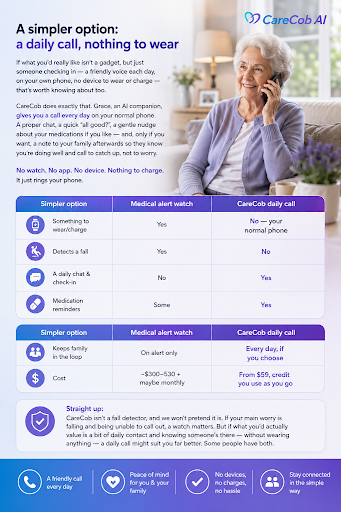
CareCob does exactly that. Grace, an AI companion, gives you a call every day on your normal phone. A proper chat, a quick "all good?", a gentle nudge about your medications if you like — and, only if you want, a note to your family afterwards so they know you're doing well and call to catch up, not to worry. If you'd like to see how it works, you can learn more before deciding if it's right for you.
No watch. No app. No device. Nothing to charge. It just rings your phone.
| Simpler option | Medical alert watch | CareCob daily call |
|---|---|---|
| Something to wear/charge | Yes | No — your normal phone |
| Detects a fall | Yes | No |
| A daily chat & check-in | No | Yes |
| Medication reminders | Some | Yes |
| Keeps family in the loop | On alert only | Every day, if you choose |
| Cost | ~$300–530 + maybe monthly | From $59, credit you use as you go |
Straight up: CareCob isn't a fall detector, and we won't pretend it is. If your main worry is falling and being unable to call out, a watch matters. But if what you'd actually value is a bit of daily contact and knowing someone's there — without wearing anything — a daily call might suit you far better. Some people have both.
Talking to your family about it
A lot of people looking into this think, "I'll mention it to my kids first." That's sensible — and it often goes better than you'd expect. Your family probably worries about you more than they let on, and something like this can actually ease their mind, not make them fuss.
If it helps, here's a simple way to raise it:
"I've been looking at ways to stay safe and independent at home. There's a daily check-in call — nothing to wear, just a call on my normal phone — and I'd like to try it. The first bit's free. Would you feel better if I did?"
Framed that way, it's not "I'm struggling" — it's "I'm staying ahead of things, on my terms." Most families are relieved and glad you brought it up.
The bottom line
If you're comfortable wearing a watch and falls are your main concern, a good medical alert watch is a solid choice — look for real fall detection, decent battery, and waterproofing, and check if you qualify for funding first.
But if you'd rather not wear a device at all, and what you'd really value is a daily voice and a bit of company, you can try CareCob's first 30 minutes free — Grace just calls your normal phone. Nothing to set up, nothing to wear.
Either way, looking into this means you're doing the smart, independent thing — staying a step ahead, on your own terms.
Frequently asked questions
Does a medical alert watch mean I can't live independently?▼
Not at all — it's the opposite. It's a tool that helps you keep living independently in your own home, with a bit of backup if you ever need it.
Do I need a smartphone or internet for one?▼
Usually no — many use their own mobile SIM. And a daily check-in call like CareCob needs nothing but your normal phone, even a landline.
How much does a medical alert watch cost in Australia?▼
Around $300–530 for a good 4G model with GPS, sometimes including a year of data. Watch for hidden monthly fees on cheaper ones.
What if I don't want to wear a device?▼
Completely fair — many people don't. A daily check-in call is the simplest option, because there's nothing to wear or charge.
Can I get help paying for it?▼
Possibly, through Support at Home, CHSP or state programs. Call My Aged Care on 1800 200 422 to check.
Related guides
General information only, not medical or financial advice. For personalised guidance, contact My Aged Care on 1800 200 422.