How Much Is a Level 4 Home Care Package in Australia? (2026)

Quick answer: A Level 4 Home Care Package provides approximately $62,589 per year in government funding under the old system (for those who transitioned before November 2025). Under the new Support at Home programme (for new applicants from November 2025), the equivalent high-level classifications provide $62,011 to $78,106 per year. This translates to roughly 20-28 hours of care per fortnight — but actual hours depend on what services you choose and your provider's fees.
If you are researching Level 4 home care package funding, there is one important thing to know before we go any further: the system changed in November 2025.
The old four-level Home Care Packages system (including Level 4) was replaced by the new Support at Home programme — which uses eight funding classifications. But both are still relevant depending on your situation. This guide covers both clearly.
How Much Is a Level 4 Home Care Package Worth?
The exact amount depends on whether you are on the old or new system.
| System | Annual Amount | Quarterly Budget | Who This Applies To |
|---|---|---|---|
| Old Level 4 (transitioned recipients) | ~$62,589/year | ~$15,647/quarter | People on Level 4 before November 2025 — automatically transitioned to Support at Home |
| Support at Home Classification 7 (new) | ~$62,011/year | ~$15,503/quarter | New applicants assessed as needing high-level care under Support at Home |
| Support at Home Classification 8 (new) | ~$78,106/year | ~$19,527/quarter | New applicants with the most complex care needs — this level did not exist under the old system |
Note: These amounts include 10% allocated for care management. Your usable service budget is approximately 90% of these figures. Amounts are indexed annually in July. Source: health.gov.au.
Important — if you see different numbers on other websites
Some websites still quote old amounts like $30,510 or $61,440 for Level 4. These are outdated figures from previous financial years. The correct 2025-26 annual amount for transitioning Level 4 recipients is approximately $62,589. For new Support at Home recipients, the equivalent is Classification 7 ($62,011) or Classification 8 ($78,106).
What Does Level 4 Funding Per Day and Per Week Look Like?
Breaking the annual amount down helps families understand what they are working with each day and week.
| Timeframe | Level 4 / Class 7 | Class 8 (new max) | Notes |
|---|---|---|---|
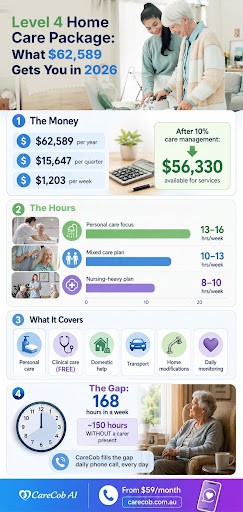
| Per year | $62,589 | $78,106 | Before provider fees |
| Per quarter | $15,647 | $19,527 | Budget released each quarter — July, Oct, Jan, Apr |
| Per month (approx) | $5,216 | $6,509 | Approximate — budgets are quarterly not monthly |
| Per week (approx) | $1,203 | $1,502 | Before care management deduction |
| Usable for services (after 10% care mgmt) | $56,330/year | $70,295/year | What actually gets spent on direct care services |
How Many Hours of Care Does Level 4 Provide Per Week?
How many hours is a level 4 home care package?
This is the question families ask most after the funding amount — and the answer is not straightforward, because it depends entirely on which services you choose.
The reason is that different services have very different hourly costs under Support at Home:
- Personal care worker: approximately $70–90 per hour
- Nursing (clinical care): approximately $150–210 per hour — but 100% government-funded, so zero out of pocket
- Physiotherapy / OT: approximately $150–200 per hour — also government-funded
- Domestic assistance: approximately $60–80 per hour
| Care Mix Scenario | Hours Per Fortnight | Hours Per Week | Notes |
|---|---|---|---|
| Mainly personal care + domestic help | 26-32 hours | 13-16 hours | Most common for physical disability, frailty |
| Heavy nursing + allied health focus | 16-20 hours | 8-10 hours | Clinical care costs more per hour but is zero out of pocket |
| Balanced mix — typical Level 4 plan | 20-26 hours | 10-13 hours | Most Level 4 recipients fall in this range |
| Weekends / evenings only — higher rate | 16-18 hours | 8-9 hours | After-hours care costs 25-35% more |
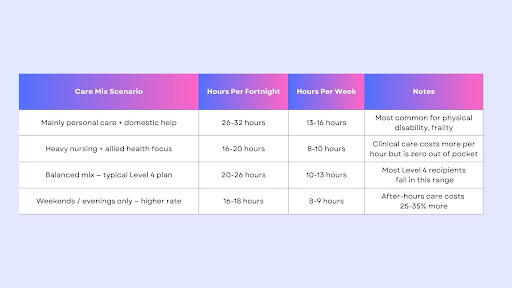
Key insight: Clinical services like nursing and physiotherapy are 100% government-funded under Support at Home — they do not reduce your personal care budget. This means your $62,589 goes further if your care plan includes nursing as well as personal care.
Provider fees matter enormously at Level 4
Two providers delivering the same services can charge very differently. One provider charging 20% in management fees gives you roughly $50,071 for direct services. Another charging 10% (the current cap) gives you $56,330. That is 2-3 extra hours of care per week from the same funding.From 1 July 2026, government price caps apply to all services — this protects Level 4 recipients from excessive charges.
What Does a Level 4 Home Care Package Cover?
Level 4 funding helps older Australians continue receiving aged care at home instead of moving into residential care.
| Category | What's Included | Who Pays |
|---|---|---|
| Clinical care | Nursing visits, wound care, medication management, physiotherapy, occupational therapy, podiatry, speech therapy | Government — 100% funded, zero out-of-pocket |
| Personal care | Help with showering, dressing, grooming, continence, mobility, getting in and out of bed | Partial contribution based on your income |
| Domestic help | Cleaning, laundry, meal preparation, gardening, shopping | Contribution required — higher than personal care |
| Transport | To medical appointments, social activities, shopping | Contribution required |
| Home modifications | Ramps, grab rails, bathroom modifications, non-slip flooring (clinically recommended) | Separate AT-HM budget — does not come from your quarterly care budget |
| Equipment | Hospital beds, wheelchairs, hoists, walking frames, personal alarms | Separate AT-HM budget |
| Social support | Companion visits, daily phone check-ins, community activities, respite care | Partial contribution based on income |
| Respite care | Temporary care to give family carers a break | Included at Level 4 — important for carer wellbeing |
What Does a Real Level 4 Care Plan Look Like?
This is an example of what a typical Level 4 home care plan might look like for a week. This is illustrative — actual care plans are tailored to individual needs and goals.
Example: Margaret, 82, living alone in Brisbane. Margaret has moderate dementia, heart failure, and limited mobility following a hip replacement. She lives alone and her daughter lives in Melbourne. Her son-in-law visits on weekends.
| Day | Services | Who Provides |
|---|---|---|
| Monday | Morning personal care (shower, dress, breakfast) — 1.5hrs; Daily phone check-in from CareCob Grace; Cleaning and laundry — 2hrs | Personal care worker; CareCob AI; Domestic worker |
| Tuesday | Personal care — 1hr; Physiotherapy — 1hr (government-funded); CareCob daily check-in | Care worker; Physiotherapist; CareCob AI |
| Wednesday | Personal care + medication management — 1.5hrs; OT review — 1hr (government-funded); CareCob daily check-in | Nurse / care worker; OT therapist; CareCob AI |
| Thursday | Personal care — 1hr; Transport to GP + assistance — 2hrs; CareCob daily check-in | Care worker; Transport support; CareCob AI |
| Friday | Personal care — 1hr; Nursing visit — wound care — 1hr (government-funded); Meal preparation — 1hr; CareCob daily check-in | Care worker; Registered nurse; Meals support; CareCob AI |
| Saturday | Respite carer — son-in-law provides personal care; CareCob daily check-in — daughter receives SMS update | Family; CareCob AI |
| Sunday | Personal care — 1hr; CareCob daily check-in — keeps Margaret connected and reassures family | Care worker; CareCob AI |
Total weekly service hours: approximately 12-14 hours of paid care worker time. Note that CareCob's daily phone check-ins occur every day — filling the gap between care visits and ensuring Margaret's daughter receives a daily update regardless of where she lives.
Who Qualifies for Level 4 / High-Level Classification?
Level 4 — and its equivalent Support at Home Classifications 7 and 8 — is for people whose care needs cannot be met at lower levels and who would otherwise need to consider moving into residential aged care.
You may qualify for Level 4 / Classification 7-8 if you:
- Require assistance with most activities of daily living — showering, dressing, mobility, continence
- Have complex health conditions requiring regular nursing, specialist care, or allied health
- Have advanced dementia requiring daily supervision and support
- Have had recent hospitalisations or falls requiring intensive recovery support
- Are living with a progressive condition such as Parkinson's disease, heart failure, or multiple chronic illnesses
- Cannot safely live alone without daily professional support
Waiting times for Level 4 in 2026
Level 4 has the longest wait times of all package levels. As of December 2025, the home care waiting list had over 130,000 people. Waits of 9 to 18 months for high-level classifications are common.While waiting: Apply for interim Support at Home funding (60% of your full classification). Also explore the Commonwealth Home Support Programme (CHSP) for basic services while you wait.Important: Do not delay applying. The clock starts from your assessment date — not from when you start receiving services.
Filling the Gaps Between Level 4 Carer Visits
Even with 10-15 hours of professional care per week from a Level 4 package, your elderly parent still spends the majority of their time alone — approximately 150 hours per week without a carer present.
For families living far away, this is where the anxiety lives. Did Mum take her medication this morning? Is she eating? Why isn't she answering her phone?
This is exactly the gap CareCob was built to fill.
How CareCob works alongside a Level 4 care plan
- Daily phone call: Grace calls your loved one every morning on their regular phone — they just answer like a normal call. No app. No screen.
- Medication reminder: Grace checks whether your loved one has taken their medications — critical for people with complex health conditions on multiple medications.
- Mood and wellbeing check: Grace notices changes in mood, energy, or cognitive state — and flags anything unusual to your family.
- Family update: You receive a daily SMS so you always know your parent is okay — without calling them five times a day.

| Without daily monitoring | With CareCob alongside Level 4 care |
|---|---|
| Family calls constantly to check in — stressful for everyone | One daily Grace call. One daily SMS to family. Done. |
| Missed medications between nursing visits | Daily reminder from Grace — every day without fail |
| Family living interstate cannot tell if parent is declining | Daily mood and wellbeing data helps family spot changes early |
| 150+ hours per week alone with no contact | Daily connection reduces loneliness and keeps Grace checking in |
| Emergency situations may go unnoticed for hours | Flagging system alerts family to anything concerning |
CareCob plans start from $59 AUD per month. Your first 30 minutes are free. Start your free trial at carecob.com.au, or speak to your home care package provider about including CareCob as part of your social support services.
Level 4 Home Care vs Residential Aged Care — Which Is Right?
This is the real question many families are wrestling with when they reach Level 4 care needs. Home care versus a residential aged care facility.
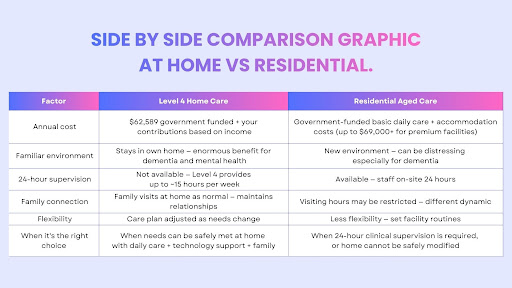
There is no single right answer — it depends on the individual's needs, home environment, family support, and personal preference. But here is an honest comparison:
The research consistently shows that elderly Australians who stay in their own homes have better mental health outcomes, slower cognitive decline, and higher reported quality of life. Level 4 home care, when supplemented with daily monitoring technology like CareCob, can make staying home safely possible for longer.
| Factor | Level 4 Home Care | Residential Aged Care |
|---|---|---|
| Annual cost | $62,589 government funded + your contributions based on income | Government-funded basic daily care + accommodation costs (up to $69,000+ for premium facilities) |
| Familiar environment | Stays in own home — enormous benefit for dementia and mental health | New environment — can be distressing especially for dementia |
| 24-hour supervision | Not available — Level 4 provides up to ~15 hours per week | Available — staff on-site 24 hours |
| Family connection | Family visits at home as normal — maintains relationships | Visiting hours may be restricted — different dynamic |
| Flexibility | Care plan adjusted as needs change | Less flexibility — set facility routines |
| When it's the right choice | When needs can be safely met at home with daily care + technology support + family | When 24-hour clinical supervision is required, or home cannot be safely modified |
How to Apply for Level 4 Home Care in 2026
- Step 1: Call My Aged Care on 1800 200 422 or register at myagedcare.gov.au. This is the only way to access government-funded care.
- Step 2: An assessor will contact you to arrange a comprehensive home assessment. For Level 4, this will be a detailed assessment covering all aspects of care need.
- Step 3: If approved for high-level care (Classification 7 or 8 under Support at Home), you will be placed in the priority queue. Request interim funding while you wait — 60% of your full classification is available immediately.
- Step 4: When funding is allocated, you have 56 days to choose an approved provider. Compare provider fees carefully — fee differences directly affect how many hours of care you receive.
- Step 5: Work with your provider to develop a care plan. Under the new Aged Care Act, you must be actively involved in this process. Your care plan should address all needs — including social support and daily monitoring.
While waiting for Level 4 approval:
1. Apply for interim Support at Home funding — 60% of your full classification2. Contact the Commonwealth Home Support Programme (CHSP) for basic services while you wait3. Consider CareCob's daily check-in service — provides daily monitoring and family peace of mind from $59/month4. Document all care needs and any hospital admissions — this strengthens your case for high-level care
Frequently Asked Questions
How much is a Level 4 home care package in 2026?▼
A Level 4 home care package provides approximately $62,589 per year in government funding for those who transitioned before November 2025. Under the new Support at Home programme, the equivalent high-care classifications are Classification 7 (~$62,011/year) and Classification 8 (~$78,106/year). After 10% care management, approximately $56,330-$70,295 is available for direct services.
How many hours of care does a Level 4 home care package provide per week?▼
A Level 4 home care package typically provides between 10-16 hours of care per week, depending on what services you choose and your provider's hourly rates. Care plans with heavy nursing and allied health provide fewer hours but include high-value clinical services fully funded by the government. Care plans focused on personal care and domestic assistance provide more hours.
What is the difference between Level 4 and Support at Home Classification 7 or 8?▼
Level 4 was the highest level under the old home care package system. Support at Home Classification 7 ($62,011/year) is broadly equivalent to old Level 4. Classification 8 ($78,106/year) is a new, higher level that did not exist before — providing more funding for people with very complex needs who need more support than the old Level 4 maximum covered.
Is there a daily phone check-in service that can be funded through Level 4?▼
Yes. Daily phone-based check-in services are classified as social and independence support under Support at Home. CareCob provides daily AI companion calls — your loved one just answers their regular phone. Grace checks on their wellbeing, provides medication reminders, and sends a daily SMS update to family. Plans from $59/month. See how it works — free trial at carecob.com.au.
Can I stay at home with Level 4 care rather than going to a residential facility?▼
Many people with Level 4 / Classification 7-8 needs do successfully stay at home. The key factors are whether the home can be safely modified, whether 24-hour supervision is required, and whether family support is available outside care hours. Technology like daily monitoring through AI companion calls (CareCob) and personal alarms significantly extends the time people can safely remain at home.
How do I apply for a Level 4 home care package?▼
Contact My Aged Care on 1800 200 422 or register at myagedcare.gov.au. An assessor will conduct a comprehensive home assessment to determine your care needs. If approved for high-level care, you are placed in the priority queue. Request interim funding while waiting — 60% of your full classification is available immediately. When funding is allocated, you have 56 days to choose an approved provider.
How long do I have to wait for Level 4?▼
Level 4 and equivalent high-level Support at Home classifications have the longest wait times. As of December 2025, waits of 9-18 months are common for high-level classifications. The waiting list reached over 130,000 people by end of 2025. Apply immediately after assessment — the clock starts from your assessment date, not your service start date. Interim funding (60% of full classification) is available while waiting.
Daily Monitoring Between Level 4 Care Visits
CareCob's AI companion Grace calls your elderly loved one every day on their regular phone — daily SMS updates for your family. Plans from $59 AUD per month with a free 30-minute trial.