Home Care Package Levels Australia — 2026 Funding Amounts Explained

If you are researching home care package levels in Australia, there is something important to know upfront: the system changed significantly on 1 November 2025.
The old four-level Home Care Packages system (Levels 1, 2, 3, and 4) has been replaced by the Support at Home programme, which now uses eight funding classifications. These new support at home classifications provide a more detailed way to match funding to individual care needs.
But both systems are still relevant in 2026. If you were already on a home care package before November 2025, you have transitioned automatically and your funding is based on the old levels. If you are applying for the first time, you will enter the new system.
This guide covers both. We will explain what each old level meant, what the new classifications mean, exactly how much home care package funding amounts in 2026 each level provides, and what services are covered at every level.
Quick answer for busy families: Old system (pre-Nov 2025): 4 levels (Level 1 basic → Level 4 high care)New system (from Nov 2025): 8 classifications (Classification 1 lowest → Classification 8 highest)Funding ranges from around $10,731/year (lowest) to $78,106/year (highest)If your parent already has a package: they automatically transitioned. Services continue. No reapplication needed.
What Are Home Care Package Levels?
Home care package levels determine how much government funding an elderly Australian receives for approved in-home care. The higher the level, the more complex the care needs — and the more funding provided.
Under the old system, there were four levels. Under the new Support at Home programme, there are eight classifications. The purpose is the same: to match funding to the actual care needs of each individual.
Funding is not means-tested. Eligibility is based entirely on assessed care needs — not your income or assets. Financial contributions are assessed separately after eligibility is confirmed.
The Old System — Home Care Package Levels 1 to 4 (Pre-November 2025)
If you or your parent was receiving a home care package before 1 November 2025, your funding was based on one of four levels. You have automatically transitioned to Support at Home — but understanding the old levels helps explain where you are in the new system.
The funding amounts below are the annual government subsidies under the old system (2024-25 rates):
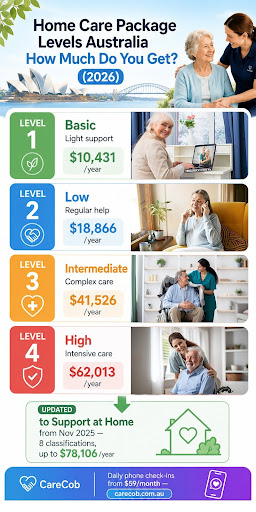
Level 1 — Basic Care
Annual funding: ~$10,431 per year | Quarterly: ~$2,608 per quarter
Who this is for: People with basic care needs — minor support to live independently at home
Services typically include: Light housekeeping, occasional transport to appointments, and basic aged care at home services
Level 2 — Low-Level Care
Annual funding: ~$18,866 per year | Quarterly: ~$4,717 per quarter
Who this is for: People needing regular ongoing support with daily activities
Services typically include: Regular personal care, cleaning, meal preparation, medication reminders, transport, companionship visits
Level 3 — Intermediate Care
Annual funding: ~$41,526 per year | Quarterly: ~$10,382 per quarter
Who this is for: People with complex care needs including health management
Services typically include: Daily personal care, nursing support, allied health (physio, OT), home modifications, dementia support, daily companion calls
Level 4 — High-Level Care
Annual funding: ~$62,013 per year | Quarterly: ~$15,503 per quarter
Who this is for: People with significant, complex care needs requiring intensive daily support
Services typically include: Round-the-clock support, specialist nursing, multiple allied health services, complex equipment, intensive daily monitoring
Important — already on a package?
If you transitioned from the old system, your Support at Home funding is equivalent to your previous level. Level 1 → Classification 1, Level 2 → approximately Classification 2-3, Level 3 → approximately Classification 4-5, Level 4 → approximately Classification 6-8. All unspent funds from your old package transferred across.
The New System — Support at Home Classifications 1 to 8 (2026)
From 1 November 2025, all new applicants enter the Support at Home programme. Instead of four levels, there are now eight funding classifications — providing more precise matching of funding to care needs.
The funding amounts below are effective from 1 November 2025 and include 10% allocated for care management. They are indexed annually in July.
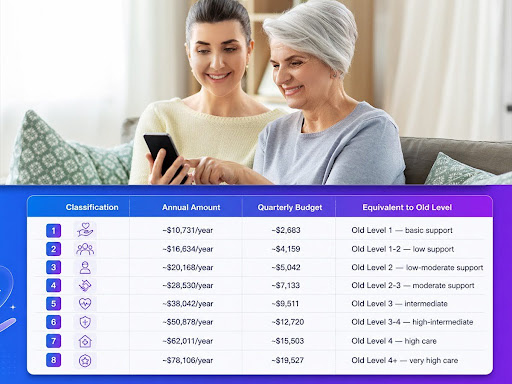
| Classification | Annual Amount | Quarterly Budget | Equivalent to Old Level |
|---|---|---|---|
| 1 | ~$10,731/year | ~$2,683 | Old Level 1 — basic support |
| 2 | ~$16,634/year | ~$4,159 | Old Level 1-2 — low support |
| 3 | ~$20,168/year | ~$5,042 | Old Level 2 — low-moderate support |
| 4 | ~$28,530/year | ~$7,133 | Old Level 2-3 — moderate support |
| 5 | ~$38,042/year | ~$9,511 | Old Level 3 — intermediate |
| 6 | ~$50,878/year | ~$12,720 | Old Level 3-4 — high-intermediate |
| 7 | ~$62,011/year | ~$15,503 | Old Level 4 — high care |
| 8 | ~$78,106/year | ~$19,527 | Old Level 4+ — very high care |
Source: Department of Health and Aged Care — Schedule of Subsidies and Supplements (health.gov.au). Amounts effective 1 November 2025, indexed July annually.
Key 2026 changes to know
1. Quarterly budgets: Funding is released in quarters (July, Oct, Jan, Apr). You cannot access the full annual amount upfront. 2. Rollover limit: You can roll over the higher of $1,000 or 10% of your quarterly budget. Amounts above this do not carry forward. 3. 10% care management: 10% of each quarterly budget is automatically deducted for care management — this is capped and lower than the old system where some providers charged up to 35%. 4. Price caps from July 2026: From 1 July 2026, government-set price caps apply to every service. Providers cannot charge above these rates.
How Much Is a Level 4 Home Care Package Worth in 2026?
How much is level 4 home care package funding worth?
This is one of the most searched questions from Australian families — and the answer depends on which system you are referring to.
Under the old Level 4 system (transitioning recipients): if your elderly parent was on Level 4 before November 2025, their annual funding was approximately $62,013 per year — or around $15,503 per quarter.
Under the new Support at Home system (new applicants): the equivalent high-care classifications are Classification 7 ($62,011/year) or Classification 8 ($78,106/year), depending on assessed needs.
Classification 8 represents the highest level of funding available under Support at Home — significantly more than the old Level 4 maximum. This means some people with high complex needs are now receiving more funding than they did under the old system.
What can you spend Level 4 / Classification 7-8 funding on?:
At the highest funding levels, packages typically cover: daily personal care, specialist nursing visits, multiple allied health sessions per week (physio, OT, podiatry, speech therapy), significant home modifications, complex equipment, intensive daily monitoring, and substantial social and companionship support. For a practical breakdown of what every level can be spent on, see our guide: What Can I Spend My Aged Care Package On?
What Services Does Each Level Cover?
While the specific home care services depend on your individual care plan, here is a general guide to what each level typically provides:
| Level / Class | Typical Weekly Care Hours | Key Services | Who It Suits |
|---|---|---|---|
| Level 1 / Class 1-2 | 2-3 hours/week | Light housekeeping, basic transport, occasional social support | Independent elderly person needing minor help with tasks |
| Level 2 / Class 3-4 | 4-6 hours/week | Personal care, cleaning, meals, medication reminders, daily phone check-ins | Person needing regular help — still largely independent |
| Level 3 / Class 5-6 | 8-12 hours/week | All of Level 2 plus nursing, allied health, dementia support, home modifications | Complex care needs — multiple health conditions |
| Level 4 / Class 7-8 | 15-20+ hours/week | All of Level 3 plus intensive nursing, specialist care, significant equipment | Very high care needs — requires daily professional support |
Note: These are indicative hours only. Actual hours depend on provider hourly rates, care management fees, and individual care plans. A provider charging lower fees gives you more hours from the same funding.
How Is Your Level or Classification Determined?
Your funding level is determined by an aged care assessment — not by you or your family. Here is the process:
- Step 1: Contact My Aged Care on 1800 200 422 or register at myagedcare.gov.au. This is always the first step — you cannot access funding without going through My Aged Care.
- Step 2: An assessor contacts you to arrange an Integrated Assessment (the new tool replacing the old ACAT). This is usually done at home. They assess mobility, health conditions, daily living ability, cognitive function, and safety.
- Step 3: Based on the assessment, a funding classification (1-8) is recommended. You will receive a letter confirming this.
- Step 4: You are placed in a priority queue. When funding becomes available, you have 56 days to choose an approved provider.
- Step 5: Work with your chosen provider to develop a care plan and start receiving services.
Waiting times in 2026
As of late 2025, the waiting list had grown to over 130,000 people. Wait times vary — a few months for lower classifications, over 12 months for the highest. While waiting, you may be eligible for interim support through the Commonwealth Home Support Programme (CHSP). Interim Support at Home funding (60% of your full classification) may also be available while you wait for full funding.
What Level Do You Need for Daily Check-ins and Companionship?
This is a question many families ask — and the answer is that daily phone check-ins and companionship support are available at every level, from Level 1 upward.
Under Support at Home, social and companionship support is classified as an Independence service. This means it is partially funded by the government with a contribution from you based on your income and assets — assessed through servicesaustralia.gov.au.
Even at the lowest funding levels, families can include daily check-in services in their care plan. At higher levels, more comprehensive daily contact is possible.
How CareCob fits into every package level:
CareCob's AI companion Grace calls your elderly loved one every day on their regular phone — they just answer like a normal call. No app. No technology to learn. Just answer the phone.
This kind of daily phone-based check-in provides three things that matter at every funding level:
- Daily contact: reducing loneliness between carer visits at Level 1 all the way through to Level 4
- Medication reminders: important at every level — missed medications are the number one cause of preventable hospital admissions in elderly Australians
- Family updates: daily SMS to family members — they always know their parent is okay without calling constantly
| Package Level | The Care Gap | How CareCob Helps |
|---|---|---|
| Level 1 / Class 1 | 2-3 hours of carer time per week — 165 hours alone | Daily phone call provides connection in the hours between visits |
| Level 2 / Class 3 | Regular help but gaps between visits | Daily check-in ensures medication reminders and family peace of mind |
| Level 3 / Class 5 | Complex needs — family worry increases | Daily update to family reduces stress for adult children living far away |
| Level 4 / Class 7 | Intensive care — but still 23 hours per day without a carer | Continuous daily connection supplements professional carer visits |
CareCob plans start from $59 AUD per month. Your first 30 minutes are free — no credit card required to start. Start your free trial at carecob.com.au, or speak to your home care package provider about including CareCob in your care plan.
Can You Switch Levels?
Yes. If your care needs change and you require additional home care package support, you can request a reassessment at any time.
If reassessed and approved for a higher classification, your funding increases from the date of the new assessment. You cannot backdate the increase.
Important: If you are currently on a transitional classification (old Level 1-4 mapped to the new system), a reassessment after 1 November 2025 will result in you receiving an ongoing services classification — which may change your contribution requirements.
If you believe the assessment underestimated your needs, you have the right to request a review. Advocacy groups like COTA Australia and Aged Care Advocacy Network can assist.
Frequently Asked Questions
What are the home care package levels in Australia?▼
Australia's original home care package system had four levels — Level 1 (basic, ~$10,431/year) through to Level 4 (high care, ~$62,013/year). From 1 November 2025, this was replaced by the Support at Home programme with eight funding classifications ranging from approximately $10,731 to $78,106 per year.
How much is a Level 4 home care package worth in 2026?▼
If you are a transitioning recipient who was on Level 4 before November 2025, your annual funding is approximately $62,013 per year (~$15,503 per quarter). New applicants assessed as requiring equivalent care under Support at Home will receive Classification 7 (~$62,011/year) or Classification 8 (~$78,106/year), depending on assessed needs.
How is my home care package level determined?▼
Your funding level is determined by an aged care assessment — not by income or assets. You register through My Aged Care (1800 200 422 or myagedcare.gov.au), and an assessor visits you at home. The assessment determines your classification. You cannot choose your level — it is based on assessed need.
Can you get daily phone check-ins funded through a home care package?▼
Yes. Daily phone-based check-ins and AI companion services like CareCob are classified as social and independence support under Support at Home. These can be included in your care plan at any funding level for companionship between carer visits. CareCob provides daily phone calls from an AI companion — your loved one just answers the phone. Plans from $59 AUD/month. See how it works for families using daily check-ins.
How long is the wait for a home care package?▼
Wait times vary significantly. As of late 2025, over 130,000 Australians were on the waiting list. Lower classifications may take a few months. Higher classifications can take 12 months or more. While waiting, interim Support at Home funding (60% of your full classification) may be available. The Commonwealth Home Support Programme (CHSP) may also provide interim support.
What happens to my home care package under Support at Home?▼
If you were on a home care package before 1 November 2025, you automatically transitioned to Support at Home with a funding classification equivalent to your old level. Your services continued without interruption. Your unspent funds carried across. If you were approved for a package after 12 September 2024, new means-tested contribution rules apply to your independence and everyday living services.
Can I increase my home care package level?▼
Yes. If your care needs have increased, you can request a reassessment through My Aged Care at any time. If assessed for a higher classification, your funding increases from the reassessment date. If you believe your initial assessment was too low, you can request a review. Contact COTA Australia or the Older Persons Advocacy Network for free assistance with the review process.
Daily Phone Check-ins at Every Package Level
CareCob's AI companion Grace calls your elderly loved one every day — they just answer the phone. Daily SMS updates for your family. Plans from $59 AUD per month with a free 30-minute trial.