Home Care Package Fees Australia — What Families Actually Pay

Few topics cause more confusion for Australian families than aged care fees. Ask five different providers "how much will this actually cost me?" and you'll often get five different answers — partly because the fee structure has genuinely changed in the last year, and partly because older information is still floating around online describing a system that no longer exists in its original form.
This guide breaks down exactly what families pay today, what changed, what didn't, and how to avoid the most common cost surprises. We'll also look at how the right combination of professional care and everyday support technology can help every dollar of funding go further.
The System Has Changed — Here's What "Home Care Package" Means Now
For years, "Home Care Package" referred to a four-level system (Levels 1 through 4) that allocated an annual budget based on assessed need. Many families still search using this exact language, and it remains a useful shorthand — but as of 1 November 2025, the home care packages levels Program was formally replaced by Support at Home, a new model built around eight funding classifications instead of four levels.
If you were already receiving a Home Care Package before the transition, a "no worse off" protection applies — your funding classification and contribution rates carry over so your out-of-pocket costs don't increase purely because of the reform. If you're a new applicant in 2026, you'll be assessed directly under the new Support at Home classification system.
Either way, the underlying question families are really asking — what will I actually pay? — has a more transparent answer under the new system than it used to, once you understand how the pieces fit together.

What Fees Actually Exist Today
Here's the most important structural change: there is no basic daily fee for home care under Support at Home. That fee only applies in residential aged care facilities. At home, the fee structure works differently — you contribute a percentage of the cost of each individual service you receive, rather than a flat daily charge.
This means your actual bill depends on three things:
- 1. What type of service you're receiving (clinical, independence, or everyday living — explained below)
- 2. Your income and assets, assessed through Services Australia
- 3. How much of each service you use in a given period
There's no such thing as a single universal "home care package fee" figure that applies to everyone — which is exactly why so many families feel confused searching for one. What you can know in advance is the structure, even if the exact dollar figure depends on your circumstances.
The Three Contribution Categories Explained
Support at Home groups every funded service into one of three categories, and each has a completely different fee outcome.
Clinical Supports — you pay nothing. Nursing care, physiotherapy, occupational therapy, and other health-related clinical services are fully funded by the government regardless of your income or assets. There's no means test for this category at all.
Independence Supports — a moderate contribution. This covers things like personal care, assistive technology, and minor home modifications — services that specifically help you avoid hospital admission or a move into residential care. Contribution rates here currently range from around 5% (full pensioners) up to 50% (self-funded retirees without a Commonwealth Seniors Health Card). One upcoming change worth knowing: personal care specifically is scheduled to shift into the fully-funded clinical category from 1 October 2026, removing the co-contribution for that particular service.
Everyday Living Supports — the highest contribution. Domestic assistance, cleaning, gardening, meal preparation, and similar practical household services sit in this category. Because these are considered more general lifestyle support rather than services that prevent hospitalisation, contribution rates are higher — ranging from roughly 17.5% for full pensioners up to 80% for self-funded retirees.
A simple way to see how this plays out: a nursing visit costing $120 might cost you nothing, personal care costing $110 might cost you around $11–$55 depending on your assessment, and a $100 cleaning service might cost you anywhere from $17.50 to $80. Same budget, very different out-of-pocket outcomes depending on which category the service falls into.
Home Care Package Levels — What Happened to Level 4 (and the Others)?
Families searching for "home care package level 4" or wanting to understand home care package levels generally are usually trying to answer one of two things: how much funding is available at each level, or what level of care does my parent actually need.
Under the legacy system, funding levels worked roughly like this:
| Former Level | Suitable For | Typical Support |
|---|---|---|
| Level 1 | Basic assistance | Occasional help with everyday activities |
| Level 2 | Low-level care | Regular domestic and personal support |
| Level 3 | Intermediate care | Ongoing personal care, wellbeing support, and health services |
| Level 4 | High-level care | Comprehensive assistance for complex, high-need care requirements |
A Level 4 care package — the highest of the original four tiers — was designed for people with the most complex needs: significant mobility limitations, complex medication management, high personal care needs, and frequent clinical input. Under Support at Home, this level of need is now captured by the higher of the eight new classifications, which carry a larger quarterly budget and a correspondingly broader mix of clinical, independence, and everyday living services. If you're comparing "levels," the practical takeaway is this: the need that used to map to Level 3 or Level 4 hasn't disappeared — it's just measured and funded through a more granular eight-tier system now, with quarterly (rather than purely annual) budgets that are reassessed as circumstances change.
Care Management Fees — A Change Worth Knowing About
One of the most common complaints about the old Home Care Packages system was "package management fees" — administrative charges that, in some cases, consumed 30–40% of a family's entire budget before a single hour of actual care was delivered.
Under Support at Home, this has changed materially:
- Care management fees are now capped at 10% of a participant's budget
- Separate entry, exit, and administration fees are banned outright — providers can no longer charge these on top of service costs
- Government-set price caps for individual services were originally scheduled to begin from 1 July 2026, though this rollout has since been deferred, with no confirmed new start date as of the time of writing. In the meantime, the ban on separate entry/exit/admin fees remains in force, and the Aged Care Quality and Safety Commission can order refunds where overcharging occurs.
Practically, this means far more of your funding should reach actual service delivery rather than administrative overhead — a meaningful shift from the older system, where opaque management fees were one of the biggest sources of family frustration.
What Actually Determines How Much You Pay
Two things drive your personal contribution level: your pension status and your assessed income and assets. Full pensioners sit at the lower end of every contribution band. Part-pensioners pay a moderate amount. Self-funded retirees without a Commonwealth Seniors Health Card sit at the higher end.
There are also annual and lifetime caps on how much you can be asked to contribute — once you hit the cap, you stop paying that particular contribution until the next reset period. There's also a combined lifetime cap across Support at Home and residential aged care, so costs paid in one setting count toward the overall limit if you later transition between the two.
If you were already receiving a package before the reform, remember the "no worse off" protections — your discounted contribution schedule generally uses lower percentages than the standard rates applied to brand-new participants.
A Realistic Cost Scenario
To make this concrete: imagine a part-pensioner receiving a mix of services each fortnight — a nursing visit, some personal care hours, and fortnightly house cleaning.
- Nursing visit (clinical) $0 out of pocket
- Personal care hours (independence, moderate contribution band) a modest percentage of the service cost
- House cleaning (everyday living, higher contribution band) the largest percentage of the three, though still government-subsidised
The exact dollar total varies enormously by state, provider, and individual assessment — which is exactly why a fee estimate from My Aged Care or your provider, based on your actual circumstances, is more useful than any single number quoted online.
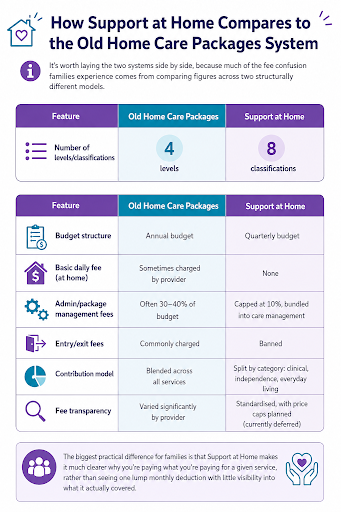
How Support at Home Compares to the Old Home Care Packages System
It's worth laying the two systems side by side, because much of the fee confusion families experience comes from comparing figures across two structurally different models.
| Feature | Old Home Care Packages | Support at Home |
|---|---|---|
| Number of levels/classifications | 4 levels | 8 classifications |
| Budget structure | Annual budget | Quarterly budget |
| Basic daily fee (at home) | Sometimes charged by provider | None |
| Admin/package management fees | Often 30–40% of budget | Capped at 10%, bundled into care management |
| Entry/exit fees | Commonly charged | Banned |
| Contribution model | Blended across all services | Split by category: clinical, independence, everyday living |
| Fee transparency | Varied significantly by provider | Standardised, with price caps planned (currently deferred) |
The biggest practical difference for families is that Support at Home makes it much clearer why you're paying what you're paying for a given service, rather than seeing one lump monthly deduction with little visibility into what it actually covered.
Applying and Getting Assessed — Where Fees Enter the Picture
Fees only become relevant once you've gone through an aged care assessment, so it's worth understanding how that process affects what you'll eventually pay.
The process typically starts with registering through My Aged Care, followed by an assessment (either over the phone or in person) that looks at your physical health, cognitive function, home environment, and existing support network. This assessment determines your classification level and, indirectly, the size of your quarterly budget. A separate, independent means assessment — based on income and assets reported to Services Australia — determines your contribution percentage within the independence and everyday living categories.
It's worth noting these two assessments are separate processes: your care needs assessment decides how much funding you're entitled to, while your means assessment decides how much of the cost of non-clinical services you personally contribute. Families sometimes assume a higher care classification automatically means higher personal fees — it doesn't. A person with complex clinical needs but modest income could have a large funded budget and pay very little out of pocket, since clinical services carry no contribution at all regardless of assessed classification.
Common Fee Mistakes Families Make
A few patterns show up again and again when families are budgeting for home care:
- Assuming one flat fee applies to everything As covered above, your bill depends entirely on which category each service sits in — assuming a single percentage across your whole budget leads to inaccurate expectations.
- Not checking for banned fees Separate entry, exit, and administration charges are no longer permitted. If a provider quotes these separately, it's worth asking directly how that aligns with current rules, since the Aged Care Quality and Safety Commission can order refunds where this happens.
- Overlooking the "no worse off" protections Families who transitioned from an existing Home Care Package sometimes don't realise they're entitled to a more favourable, discounted contribution schedule than someone applying fresh — worth confirming directly with your provider if you're unsure which schedule you're on.
- Ignoring quarterly budget resets Because Support at Home budgets don't roll over as generously as the old annual system, unused funds late in a quarter can effectively go to waste if services aren't planned out. A good care manager should proactively flag this before it happens, rather than leaving families to notice unused budget after the fact.

Beyond Government Funding: Getting More From Every Dollar
- Understanding the fee structure is only half the picture. The other half is making sure the hours and dollars you do have go as far as possible — and this is where the gaps between scheduled visits matter most.
- Medication management is a good example. Missed or duplicated doses are one of the most common (and most preventable) causes of hospital admission among older Australians, and they typically happen between scheduled care visits, not during them. A simple daily medication reminder service — delivered as a friendly phone check-in rather than an app someone has to remember to open — closes that gap without consuming any of your Independence or Everyday Living budget, since it isn't a funded aged care service at all; it's a low-cost complement that sits alongside your package.
- Companionship matters just as much as logistics. An aged care companion doesn't have to be a person on the payroll — daily conversation, gentle check-ins, and a familiar friendly voice can meaningfully reduce the isolation that builds up in the long stretches between visits from a support worker. For families trying to stretch a modest Everyday Living contribution as far as possible, this kind of support extends the feeling of being cared for well beyond the hours that are actually funded.
- The right approach isn't to replace paid care with technology — it's to use both together, so professional hours are spent where they matter most (personal care, clinical needs, complex tasks), while daily companionship and reminders quietly cover the in-between moments that a fortnightly visit schedule simply can't reach. This is the exact gap CareCob AI was built to fill — providing daily wellness check-ins, medication reminders, and family updates that complement a Support at Home budget rather than drawing from it.
For Providers: Making Every Dollar of the New System Work Harder
The fee reforms haven't only changed what families pay — they've changed what providers need to deliver, and how efficiently they need to run their operations to stay viable under capped care management fees.
With administrative margins now capped at 10%, aged care software Australia providers rely on has to do far more with far less overhead. A modern intelligent care platform that consolidates rostering, budget tracking across the three contribution categories, and family communication into one system isn't a nice-to-have anymore — it's close to essential for staying compliant and financially sustainable under the new pricing rules.
This is particularly true for larger operators. Residential aged care software built for the old fee-for-service model often doesn't map cleanly onto Support at Home's category-based contribution structure, where the same client might be billed completely differently for a nursing visit versus a cleaning visit versus a personal care session — all within the same week, all against the same quarterly budget. Providers who adapt their systems to reflect this categorisation early tend to spend far less time on manual reconciliation and far less risk of accidentally breaching a client's contribution cap.
Beyond the back-office side, many providers are also looking at how technology can extend the quality of care they deliver without adding staffing costs — daily wellness check-ins and companionship calls that complement rostered visits, giving families visibility and reassurance between appointments without requiring additional funded hours. For a sector under real financial pressure from capped fees and deferred price certainty, tools that quietly extend both compliance and care quality are becoming a genuine competitive differentiator, not just an operational convenience.
Conclusion
The fee landscape for home care in Australia has genuinely improved on transparency, even if the terminology shift from "Home Care Package Levels" to "Support at Home classifications" has made the transition confusing for many families. There's no more basic daily fee at home, care management fees are capped at 10%, and hidden admin charges have been banned outright — but your actual out-of-pocket cost still depends heavily on which category a service falls into and your individual means assessment.
Understanding these mechanics — rather than searching for a single flat "home care package fee" figure — is the real key to budgeting accurately. And once the funding side is sorted, the families who get the most value tend to be the ones who pair their professional care hours with simple, low-cost daily support — companionship, medication reminders, and family updates — that quietly fill the space between visits without eating into the funded budget at all. That's the role CareCob AI plays for many Australian families: not replacing care, but making every hour of it go further.
Frequently Asked Questions
What are home care package fees in Australia right now?▼
There's no flat basic daily fee for home care under the current Support at Home system. Instead, you pay a percentage of the cost of each service you receive, based on whether it's clinical (no contribution), independence (moderate contribution), or everyday living (highest contribution), and on your personal income and assets assessment.
What happened to Home Care Package Level 4?▼
Level 4, the highest of the original four package levels, was designed for complex, high-level care needs. Since the Support at Home reform, this level of need is now captured within the higher tiers of the new eight-classification system, with a larger quarterly budget and a broader mix of clinical, independence, and everyday living services.
Do I still need to understand home care package levels if the system has changed?▼
Yes, to an extent — many providers, comparison tools, and families still use the old level language as shorthand, and if you were already on a package before the transition, your funding was carried over at an equivalent classification. New applicants are assessed directly under the eight-tier system.
Are care management fees still a major cost?▼
Care management fees are now capped at 10% of a participant's budget, and separate entry, exit, or administration fees are banned. This is a substantial change from the old system, where management fees sometimes consumed 30–40% of a family's total budget.
Can a medication reminder service help reduce costs?▼
A simple daily medication reminder isn't a funded aged care service itself, but it helps prevent missed or duplicated doses — one of the most common causes of avoidable hospital admissions — without using any of your Independence or Everyday Living contribution budget.
What does an aged care companion actually do?▼
An aged care companion provides regular conversation, wellbeing check-ins, and social connection between scheduled care visits, helping reduce the isolation that often builds up in the gaps a fortnightly or weekly visit schedule can't cover.
Why does aged care software matter more under the new fee system?▼
With care management fees capped at 10%, providers need aged care software Australia-wide that can accurately track contributions across all three service categories, avoid billing errors, and keep administrative overhead low enough to remain financially sustainable.
How is residential aged care software different from home care software needs?▼
Residential aged care software typically centres on a facility-wide, fee-for-service billing model, while home care requires an intelligent care platform capable of managing category-based contributions, quarterly budgets, and per-service billing that can vary client-to-client and week-to-week.