Independent Living Options for Elderly Australians: A Family Guide
When an older parent starts to slow down, one question quietly moves to the top of every family's mind: how can they keep their independence while staying safe? The encouraging news is that Australians have more independent living options than ever — from staying in the family home with a little support, to purpose-built units and vibrant lifestyle communities. The challenge is understanding what each one offers, what it costs, and which suits your parent's health, budget and personality.
This family guide walks through the main independent living options for elderly Australians, the trade-offs of each, the questions worth asking, and the simple daily safety net that makes any of them work.
What “independent living” really means
Independent living simply means an older person continuing to run their own life — their own home, their own routines, their own decisions — with as much or as little support as they need. It sits at the opposite end of the spectrum from residential aged care, where staff provide around-the-clock help. Most older Australians want to stay firmly on the independent end for as long as possible, and the shift in the aged care system reflects that: the number of people receiving support in their own homes has grown by more than 300% since 2017, while moves into residential care have barely changed.
Independence rarely fails all at once. It tends to erode gradually — a missed medication here, an unsteady moment there, quieter and lonelier days. The right living option, paired with the right support, is what keeps small problems from forcing a big, premature move.
The main independent living options at a glance
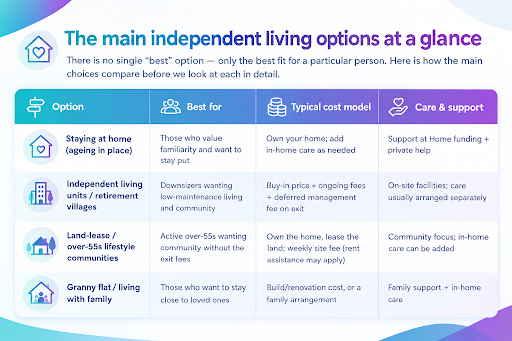
There is no single “best” option — only the best fit for a particular person. Here is how the main choices compare before we look at each in detail.
| Option | Best for | Typical cost model | Care & support |
|---|---|---|---|
| Staying at home (ageing in place) | Those who value familiarity and want to stay put | Own your home; add in-home care as needed | Support at Home funding + private help |
| Independent living units / retirement villages | Downsizers wanting low-maintenance living and community | Buy-in price + ongoing fees + deferred management fee on exit | On-site facilities; care usually arranged separately |
| Land-lease / over-55s lifestyle communities | Active over-55s wanting community without the exit fees | Own the home, lease the land; weekly site fee (rent assistance may apply) | Community focus; in-home care can be added |
| Granny flat / living with family | Those who want to stay close to loved ones | Build/renovation cost, or a family arrangement | Family support + in-home care |
1. Staying in the family home (ageing in place)
For many older Australians the preferred option is the simplest: stay put. Familiar surroundings support memory and confidence, keep people connected to their neighbourhood, and avoid the cost and upheaval of moving. With a few home-safety improvements — grab rails, better lighting, removing trip hazards — and government-funded help through the Support at Home program, staying at home is realistic for far longer than most families expect. The main things to watch are isolation and safety between visits, which is where a daily check-in becomes invaluable.
2. Independent living units and retirement villages
Independent living units (ILUs) are self-contained homes — apartments, villas or townhouses — usually within a retirement village designed for over-55s. Residents live completely independently but enjoy low-maintenance living plus shared facilities like community centres, gardens, and sometimes a pool or gym. It is a lifestyle choice as much as a housing one: downsizing into a smaller, easier home while gaining a ready-made community.
The trade-off is the contract. Retirement villages typically charge a purchase price, ongoing service fees, and a deferred management fee (also called an exit fee) — often around 30–35% of the price — deducted when you leave. It is essential to read the contract carefully and understand the exit costs before committing. Importantly, ILUs provide the home and lifestyle, not the care: any personal or clinical support is arranged separately, usually through a Support at Home package or private services.
3. Land-lease and over-55s lifestyle communities
Land-lease communities are one of the fastest-growing options for older Australians. You buy the home but lease the land it sits on, paying a weekly site fee instead of the buy-in-plus-exit-fee model of a traditional village. Because the ongoing fee is treated as rent, many residents qualify for Commonwealth Rent Assistance, which can make it surprisingly affordable. These communities are typically lifestyle-focused, with clubhouses and social calendars, and appeal to active, sociable over-55s who want community without the deferred management fee.
4. Granny flats and living near family
Some families choose to keep a parent close by — building a granny flat, converting a garage, or adding a self-contained space to the family home. This preserves independence and privacy while putting help within reach, and can be far cheaper than other options. It works best where the relationship and the practicalities suit everyone, and where the older person still has their own social world so they do not become isolated when the household is out during the day.
5. Rental and co-living options
Not every older Australian owns a home or wants to buy into a village, and there are independent options for renters too. Some seniors rent within retirement or lifestyle communities, while a growing number choose co-living or home-sharing arrangements — sharing a house with other older people to cut costs and, just as importantly, to keep loneliness at bay. These options offer flexibility and companionship without a large upfront outlay, and renters may be eligible for Commonwealth Rent Assistance to help with the cost.
How to choose the right option?
The right choice comes down to matching an option to the person. A few factors matter most:
- Health and future needs. How much support is needed now, and how might that change? Options that let you add care over time offer more longevity.
- Cost and contracts. Look beyond the entry price to ongoing fees and, for villages, exit fees. Compare the true long-term cost of each option.
- Location. Being close to family, friends, doctors and familiar shops makes a huge difference to wellbeing and how often loved ones can visit.
- Lifestyle and personality. A sociable person may thrive in a community; a private one may be happiest at home. Neither is wrong.
- Companionship and safety. Living alone — even in a lovely unit — can be isolating. Around 1 in 7 Australians aged 65 and over report feeling lonely, so a plan for daily connection matters as much as bricks and mortar.
The safety net every option needs: an aged care companion
Whatever living arrangement a family chooses, one need is universal: a reliable way to know that Mum or Dad is okay each day. Funded care covers scheduled visits, and a community offers neighbours — but neither guarantees that someone checks in every single morning, or that a medication is remembered between appointments. That everyday gap is exactly what an aged care companion service is built to fill.
CareCob is that companion. Every day, Grace — CareCob's friendly AI companion — calls your parent on their ordinary home or mobile phone (no app, no new device, nothing to learn) for a warm chat, a wellbeing check and a gentle medication reminder. If something does not sound right, or a call is missed, the family is notified straight away by SMS and through a simple dashboard.
It works anywhere your parent lives — the family home, an independent living unit, a lifestyle community or a granny flat — and it works especially well for families supporting a parent from another suburb or state. For the person at home it is company and quiet reassurance; for the family it is the peace of mind of knowing someone is checking in, even on the days they cannot be there themselves. Independence, with a safety net.
Help your parent stay independent, wherever they live. Start a 30-minute free trial of CareCob, book a demo, or view pricing — Essentials from $59, Personal $149/month, or an Enterprise plan for care providers and communities.
Frequently asked questions
What are independent living options for the elderly in Australia?▼
The main options are staying in the family home with in-home support, moving into an independent living unit or retirement village, joining a land-lease or over-55s lifestyle community, or living in a granny flat near family. Each keeps the person fully independent while offering different levels of community and cost.
What is an independent living unit?▼
An independent living unit (ILU) is a self-contained home — an apartment, villa or townhouse — usually within a retirement village for over-55s. Residents live independently and share community facilities, but personal and clinical care is arranged separately, often through a Support at Home package.
What is the difference between an independent living unit and aged care?▼
An independent living unit is a lifestyle housing choice where the person runs their own life. Residential aged care provides accommodation plus around-the-clock personal and clinical care. Many people move into an ILU or lifestyle community first and only consider residential care much later, if at all.
Are independent living communities expensive?▼
It depends on the model. Retirement villages usually charge a purchase price, ongoing fees and a deferred management (exit) fee. Land-lease communities charge a weekly site fee that may qualify for Commonwealth Rent Assistance. Always compare the full cost over five to ten years, including exit costs.
How can an elderly person stay safe living independently?▼
Through home-safety changes, a steady routine, government-funded in-home support, staying socially connected, and a daily check-in that flags problems early. An aged care companion service like CareCob provides that daily wellbeing call, medication reminder and family alert wherever the person lives.
What is an aged care companion?▼
An aged care companion provides regular, non-medical connection and reassurance for an older person — a friendly check-in, conversation and reminders. CareCob delivers this as a daily phone call from Grace, its AI companion, with wellbeing checks, medication reminders and instant updates to family.
When should a family start looking at independent living options?▼
The best time is well before it becomes urgent. Exploring options while a parent is still fit and well means decisions are made calmly rather than in a crisis, waiting lists and contracts can be researched properly, and small supports can be put in place early — keeping the choice about how and where they live firmly in the family's hands.