Home Care Packages Australia: What They Are, What They Cover, and What They Don't

If you're trying to work out whether your parent — or you — qualifies for a home care package, how much you might get, and what it actually pays for, this guide gives you a clear, honest answer. No jargon, no runaround.
💙 Quick answer: A home care package is a government-funded budget for older Australians to get help at home — personal care, domestic help, transport, equipment, and more. There are four levels ($10,600–$60,500/year). You apply through My Aged Care. Most people wait 3–12 months. The package pays a provider; you may pay a small income-tested fee on top.
What is a home care package?
A home care package is a government-subsidised budget that lets older Australians get the support they need to keep living at home — rather than moving into a residential aged care facility. The money isn't paid to you directly; it's managed through an approved provider who coordinates the services you choose.
Home care packages in Australia transitioned to the new Support at Home program. If you're researching "home care packages," you're now looking at Support at Home — same principle, updated structure and funding levels.
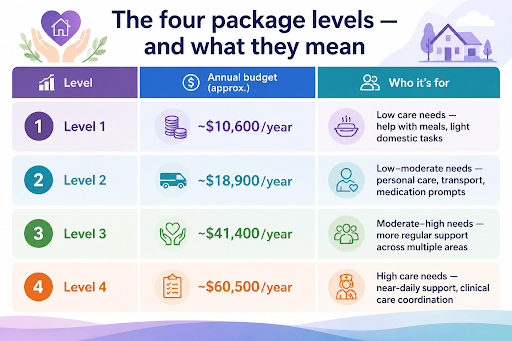
The four package levels — and what they mean
| Level | Annual budget (approx.) | Who it's for |
|---|---|---|
| Level 1 | ~$10,600/year | Low care needs — help with meals, light domestic tasks |
| Level 2 | ~$18,900/year | Low–moderate needs — personal care, transport, medication prompts |
| Level 3 | ~$41,400/year | Moderate–high needs — more regular support across multiple areas |
| Level 4 | ~$60,500/year | High care needs — near-daily support, clinical care coordination |
What a home care package can pay for?
A package can fund a wide range of support for aged care at home, including:
- ● Personal care — showering, dressing, grooming
- ● Domestic assistance — cleaning, laundry, meal preparation
- ● Transport — getting to appointments and social activities
- ● Allied health — physiotherapy, occupational therapy, podiatry
- ● Nursing care — wound care, medication management
- ● Home modifications — grab rails, ramps, bathroom safety
- ● Equipment and assistive technology — walking frames, shower chairs
- ● Social support — help to stay connected and engaged
- ● Wellness programs — exercise, nutrition support
What it cannot fund: rent, food, holidays, gambling, or services that duplicate what Medicare covers.
Who is eligible?
To be eligible for a home care package, you generally need to be:
- ● An older Australian (usually 65+, or 50+ for Aboriginal and Torres Strait Islander people)
- ● Assessed by an Aged Care Assessment Team (ACAT) as needing coordinated support at home
- ● An Australian citizen or permanent resident
The assessment is free and arranged through My Aged Care (1800 200 422). An assessor visits at home and determines which package level suits your needs.
How to apply — step by step?
- Step 1: Call My Aged Care on 1800 200 422 or register online at myagedcare.gov.au
- Step 2: Have a free in-home assessment with an ACAT assessor
- Step 3: Receive your approval letter with your assigned package level
- Step 4: Choose an approved provider and sign a Home Care Agreement
- Step 5: Work with your provider to create a care plan using your budget
How long is the wait?
Waiting times vary by level and region. In 2025–2026 most approved applicants wait 3–12 months for a Level 1 or 2 package; wait times for Level 3–4 can be longer. The government has been reducing wait times under the new Support at Home rollout, but demand is high.
While you wait, you may be eligible for interim supports through the Commonwealth Home Support Programme (CHSP).
Technology and home care: what's changing
The aged care reforms brought residential aged care technology and provider accountability into sharper focus — but the same shift is happening in home care. Providers are increasingly expected to use digital care plans, remote monitoring, and communication tools to deliver better outcomes.
Aged care facility management has also moved toward cloud-based systems, but for people receiving care at home, the more relevant technology is often simpler: a daily check-in call, a medication reminder, a friendly voice.
What a package doesn't always cover — and where families get caught out
Even with a generous Level 3 or 4 package, there are real gaps:
- ● Packages pay for scheduled services, not round-the-clock presence
- ● They don't check on your loved one between visits
- ● Medication reminders are only during scheduled support times
- ● There's no daily "are you okay?" contact unless you pay for it separately
- ● Family members often don't know how things are going between provider visits
This is the gap CareCob AI fills. Our home care services page explains what we do alongside a funded package — a daily AI check-in call to your loved one's normal phone, with a gentle update to your family. Nothing to wear or install.
| Home care package (provider visits) | CareCob daily call | |
|---|---|---|
| Covers scheduled services | Yes | Not applicable |
| Daily check-in between visits | No | Yes |
| Medication reminders daily | During visit only | Every day |
| Family update | On request/incident | Every day |
| Requires wearing a device | — | No — normal phone |
| Cost | Funded by package (+ fees) | From $59, — Credit you use as you go. Top up anytime |
To see exactly how it works, visit our how it works page — no package funding required, no device to set up.
The bottom line
A home care package (now Support at Home) is genuinely valuable for older Australians who need regular, coordinated care at home. Apply early — the wait can be long — and choose your provider carefully, because the package budget and who manages it really matters.
But a package alone doesn't mean someone is checking in every day. If that daily contact and family peace of mind matters to you, try CareCob AI first 30 minutes free — Grace just calls their normal phone. Nothing to set up, nothing to wait for.

Frequently asked questions
Who qualifies for a home care package in Australia?▼
Generally Australians aged 65+ (50+ for Aboriginal and Torres Strait Islander people) who are assessed by an ACAT as needing regular coordinated support at home. Apply through My Aged Care on 1800 200 422.
How long is the wait for a home care package?▼
Typically 3–12 months for Level 1–2 packages in 2025–26, longer for higher levels. Interim support through CHSP may be available while you wait.
How much does a home care package cost me?▼
The government funds the package. You may pay a basic daily fee (~$12–14/day) and an income-tested care fee depending on your financial situation. Your provider will explain exactly what applies to you.
What's the difference between a home care package and CHSP?▼
The Common wealth Home Support Programme (CHSP) provides entry-level support services for people with lower needs. A home care package (Support at Home) provides a larger coordinated budget for people with moderate to high needs.