Signs Your Elderly Parent Needs More Support at Home

Watching a parent age is one of the most emotional experiences a family goes through. For years, they cared for you — and now the roles are slowly reversing. But recognising exactly when an ageing parent needs more support isn't always obvious. Changes often happen gradually: a missed pill here, a skipped meal there, a small stumble that seems like nothing at the time.
Many families don't act until a crisis forces the issue — a fall, a hospital visit, or a frightening phone call. The good news is that most of these situations are preventable. By learning to recognise the early signs that an elderly parent needs more support at home, families can act proactively, explore aged care home care options, and put the right help in place before a small issue becomes a serious one.
This guide walks through the physical, cognitive, emotional, and household signs that indicate it's time to consider additional support — and how a combination of professional home care services for the elderly and intelligent technology like CareCob AI can help your loved one stay safe, independent, and connected at home for longer.
Why Recognising the Signs Early Matters
Ageing in place — remaining in one's own home rather than moving into residential care — is the preference of the overwhelming majority of older Australians. It's familiar, comfortable, and preserves independence and dignity. But ageing in place safely depends on catching changes early and responding with the right level of support.
When families wait too long to act, small issues tend to compound. A parent who's slightly unsteady on their feet but hasn't fallen yet is in a very different position from a parent who has already had a serious fall. A parent who's occasionally forgetting to take medication is in a very different position from a parent who has stopped managing their health altogether. Early intervention — through home care packages, in-home support services, or supplementary technology — gives families the chance to adapt care levels gradually, rather than being forced into a sudden, high-pressure decision during a crisis.
This is where combining traditional aged care home care with everyday monitoring tools becomes so valuable. Professional carers provide scheduled, hands-on support, while tools like CareCob AI help families stay aware of what's happening in between visits — filling the gaps that matter most.

Physical Signs Your Elderly Parent Needs More Support
Physical changes are often the easiest signs to notice, but they're also the ones families are most likely to dismiss as "just getting older."
- Unexplained bruises or injuries Bruises on the arms, legs, or hips can indicate falls or bumps into furniture that your parents haven't mentioned — often because they're embarrassed or don't want to worry you.
- Difficulty with mobility Watch for a parent gripping furniture while walking, avoiding stairs, or becoming noticeably slower and more hesitant when moving around the house. These are strong indicators that additional in-home support or mobility aids may be needed.
- Noticeable weight loss or poor nutrition An empty fridge, expired food, or skipped meals can point to difficulty cooking, shopping, or simply remembering to eat regularly. This is one of the clearest signals that home care services for the elderly — particularly meal preparation and grocery support — would make a meaningful difference.
- Poor personal hygiene A decline in grooming, wearing the same clothes repeatedly, or an unclean home environment can indicate that daily tasks have become physically difficult or that a parent is struggling cognitively to maintain routines.
- Trouble managing medications Missed doses, doubled-up doses, or a pillbox that doesn't match the prescribed schedule are red flags. Medication mismanagement is one of the leading causes of preventable hospitalisation among older Australians, and it's an area where consistent daily reminders make a substantial difference.
If you notice several of these physical signs together, it's a strong indication that it's time to look into structured aged care home care options rather than relying solely on informal family support.
Cognitive and Memory-Related Signs
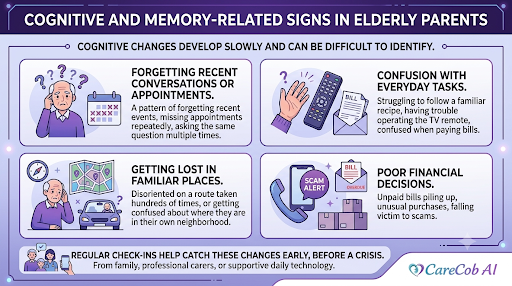
Cognitive changes can be more difficult to identify because they tend to develop slowly, and parents themselves are often unaware of — or reluctant to discuss — memory lapses.
- Forgetting recent conversations or appointments Occasional forgetfulness is normal at any age, but a pattern of forgetting recent events, missing appointments repeatedly, or asking the same question multiple times within a short period can indicate something more significant.
- Confusion with everyday tasks Struggling to follow a familiar recipe, having trouble operating the TV remote, or becoming confused when paying bills are signs that daily cognitive load has become harder to manage independently.
- Getting lost in familiar places If a parent becomes disoriented driving a route they've taken hundreds of times, or gets confused about where they are within their own neighbourhood, this warrants prompt attention and a conversation with their GP.
- Poor financial decisions Unpaid bills piling up, unusual purchases, or falling victim to scams can be an early sign of cognitive decline — and unfortunately, older Australians living alone are frequently targeted by scammers specifically because these changes go unnoticed for too long.
Regular check-ins — whether from family, professional carers, or supportive daily technology — help catch these changes early, long before they escalate into a crisis.
Emotional and Social Signs
Not all signs are physical. Emotional withdrawal is one of the most under-recognised indicators that an elderly parent needs more support.
- Increased isolation A parent who used to enjoy social activities, church groups, or catching up with friends but has gradually stopped engaging may be dealing with depression, physical difficulty getting around, or simply loneliness that's gone unaddressed.
- Loss of interest in hobbies When activities that once brought joy — gardening, reading, cooking — are abandoned, it's often a sign that something (physically or emotionally) has changed.
- Mood changes Increased irritability, sadness, anxiety, or apathy can indicate loneliness, an underlying health issue, or the emotional toll of struggling to manage daily life independently.
- Reluctance to leave the house Fear of falling, embarrassment about physical limitations, or simple loss of confidence can lead older adults to withdraw from the outside world almost entirely.
Loneliness in older adults isn't just an emotional concern — it's linked to measurable declines in physical health. This is exactly the gap that companionship-focused support, alongside traditional home care services for the elderly, is designed to close. Daily conversation, wellbeing check-ins, and consistent social contact can make a profound difference to a parent's quality of life.
Household and Environmental Signs
Sometimes the clearest signals aren't about your parents directly, but about the state of their home.
- Piles of unopened mail or unpaid bills
- Overflowing laundry or an increasingly cluttered home
- Spoiled food left in the fridge
- Missed appointments with no memory of scheduling them
- A general decline in the tidiness or safety of the living space
A home that used to be well-kept but has slowly become disorganised or unsafe is often one of the strongest indicators that daily support — through home care packages covering domestic assistance — has become necessary.
What to Do If You Notice These Signs?
If you're recognising several of these signs in your own parent, the next step is having an honest, compassionate conversation — and then looking into what kind of support actually fits their needs. Not every sign requires the same level of intervention. Some families need occasional help with housework and transport. Others need more comprehensive daily personal care and health monitoring.
This is where home care packages come in. Rather than a one-size-fits-all approach, funded home care in Australia is designed to scale to the individual — from lower-level assistance with household tasks, right through to more comprehensive personal care, nursing support, and allied health services for those with higher needs. A formal aged care assessment is the first step toward understanding which level of aged care home care is the right fit for your parent's specific situation.
For accurate, current information about assessments, eligibility, and the aged care system in Australia, the Australian Government Department of Health, Disability and Ageing is the authoritative source. It's worth visiting their official site directly for the latest guidance before making decisions, since aged care funding and eligibility criteria are reviewed and updated over time.
Why Professional Care Alone Sometimes Isn't Enough?
Traditional home care services for the elderly — carers visiting on a scheduled basis to help with meals, personal care, or housework — remain an essential part of supporting older Australians. But scheduled visits, by definition, only cover part of the day. Between visits, many seniors are left without anyone checking in on them, which is often exactly when falls happen, medications get missed, or loneliness sets in.
This is the gap that CareCob AI was built to fill. CareCob AI works alongside traditional aged care home care — never replacing it — by providing:
- Daily wellness check-ins, so families know how their parent is doing even on days without a scheduled carer visit
- Medication reminders, reducing the risk of missed or duplicated doses
- Friendly companionship conversation, helping combat the isolation that so often goes unnoticed
- Family updates, giving adult children peace of mind without needing to call every single day
- Support that complements existing home care packages, extending their value between visits rather than duplicating what carers already do
For families noticing the early signs discussed in this article, CareCob AI offers a practical way to stay closely connected to a parent's daily wellbeing — even from a distance, even between visits, and even before a formal care package is fully in place.
Making the Transition Easier for Everyone
One of the hardest parts of this process isn't identifying the signs — it's having the conversation. Many older parents resist the idea of "needing help," associating it with a loss of independence rather than a way to preserve it.
Framing the conversation around independence, rather than incapacity, tends to go further. Positioning home care services, home care packages, and supportive technology like CareCob AI as tools that help your parent stay in their own home longer — rather than as a step toward losing their autonomy — often makes these conversations considerably easier.
Starting with lighter-touch support, such as companionship check-ins or occasional household help, can also ease the transition rather than jumping straight to comprehensive personal care. As needs increase, home care packages can be reassessed and adjusted, and CareCob AI's role can expand alongside changing circumstances — creating a flexible, evolving support system rather than a single fixed solution.
Conclusion
Recognising the signs that an elderly parent needs more support — physical, cognitive, emotional, or household — is the first step toward ensuring they remain safe, independent, and well cared for at home. Whether it's help through structured home care packages, everyday aged care home care, or the kind of continuous, day-to-day support that home care services for the elderly alone can't always provide, acting early makes all the difference.
CareCob AI was built specifically to close the gaps that traditional scheduled care leaves behind — offering daily companionship, wellness check-ins, medication reminders, and family updates that help older Australians stay connected and supported every single day, not just during care visits. If you've recognised any of the signs in this article, now is the time to explore how CareCob AI can complement your family's care plan.
Frequently Asked Questions
What are the early signs that an elderly parent needs more care at home?▼
Common early signs include unexplained bruises, mobility difficulties, weight loss, poor hygiene, missed medications, memory lapses, social withdrawal, mood changes, and a noticeably less organised or unsafe home environment.
How is a home care package different from home care services?▼
Home care packages are structured, government-funded programs that allocate an annual budget for approved care services based on assessed need. Home care services for the elderly can also be arranged privately, without a package, depending on the level and type of support required.
At what point should a family consider aged care home care?▼
Families should consider aged care home care as soon as they notice a pattern of physical, cognitive, or emotional decline that affects a parent's ability to safely manage daily life — not only after a crisis such as a fall or hospitalisation.
Can technology like CareCob AI replace in-home carers?▼
No. CareCob AI is designed to complement professional home care services for the elderly, not replace them. It provides continuous companionship, wellness check-ins, and reminders between scheduled care visits.
How do I start the process of getting a home care package for my parent?▼
The first step is an aged care assessment, which determines eligibility and the appropriate level of funded support. Families can find official guidance on assessments and eligibility through the Australian Government Department of Health, Disability and Ageing.
What if my parent refuses help?▼
Framing support around preserving independence, rather than as a loss of autonomy, often makes these conversations easier. Starting with lighter support, such as companionship check-ins, can help ease the transition before moving to more comprehensive personal care.
How does CareCob AI support families who live far away?▼
CareCob AI provides daily wellness check-ins and family updates, helping adult children stay informed about their parent's day-to-day wellbeing even when they can't be there in person.